Friday, 10 July 2015

Which Pain Points Are Giving Marketers Headaches?

Marketing pain points


EconsultancySmartFocus-Marketing-Pain-Points-and-Impact-Jun2015

Forget proving ROI. That’s a headache, but not a “migraine-inducing” one, according to results from a new survey [download page] from Econsultancy and SmartFocus. Instead, the biggest pain point for client-side marketers today – of those identified – is the major bottleneck presented by IT and web development teams, per the study.
Respondents were presented with a list of 17 pain points and asked to rate them on a 5-point scale, from 1 (minor headache) to 5 (a serious migraine). The most aggravating headaches, with a top-2 box score on the “migraine rating” scale, are:
  • IT and web development teams being major bottlenecks (54%);
  • A lack of time to test and optimize campaigns (47%);
  • Desire for a single customer view without the time, budget or IT resources to build one (42%);
  • Inability to keep track of customers across different channels and on different devices (41%); and
  • Not enough budget or a decreasing budget (41%).
Generally, those leading pain points were also among the top in terms of significant perceived impact on the business, though the struggle to prove the ROI of marketing activities cracked the top 5 on that measure.
Encouragingly, only about 1 in 5 respondents complained that their senior bosses don’t care about marketing, although more (28%) saw this as having a significant impact on their business.
Beyond ranking those 17 issues on their severity and significance, the study also looks at various issues related to data, marketing technology and marketing skills. Some takeaways are highlighted below.

Data-Related Challenges

Asked which data-related challenges are pain points for their team, marketers were most likely to point to marketing attribution (48%), turning data into insights (47%) and turning insights into actionable segments (45%). In terms of severity, though, the highest proportion assigned a top-2 “migraine rating” to moving data between systems (74%), gaining a single customer view (69%) and turning data into insights (65%).
Being able to work with the data has the biggest impact on the success of marketing campaigns, too. On a 5-point scale of importance, almost 8 in 10 assigned a top-2 box score to the challenge of turning insights into actionable segments, with an equal 79% saying the same about the challenge of turning data into insights. The (in)ability to turn data into insights is a recurring problem cited in research on data-driven marketing.

Marketing Technologies

A majority of respondents to the study reported using marketing technologies such as web analytics (66%), email marketing platforms (61%) and social media management (55%), although others such as marketing automation (31%), social listening (27%) and website personalization (26%) are lower on the adoption scale.
Technology integration problems – another recurring theme – continues to be a problem, per the survey, with 63% agreeing that lack of integration makes it harder to get a single customer view. Meanwhile, only one-third agreed that they have the right marketing technology to help them meet their business objectives, and even fewer (30%) agreed that marketing technology platforms are fast and easy to use.
Surprisingly, though, only a minority of marketers assigned the various marketing technologies in question a top-2 “migraine rating,” led by data management platforms (37%), multichannel campaign management (37%), and marketing automation (36%). These tended to fall around the middle rung in terms of importance to marketing success, supplanted by more common technologies such as CRM, content management systems, web analytics, SEO technology and email marketing platforms.
As for email, there are struggles there too, with by far the most common problem being an increasing difficulty standing out in the inbox. (See the MarketingCharts report on brand email opens for more on this topic.)
Although about half personalize email content to individual customers, few are yet able to engage in other capabilities such as offering dynamic email content based on when and where customers open email (18%) and real-time decisioning capability to serve the most contextually relevant content (12%).
And while 8 in 10 agree that context is king when communicating with customers, about half as many (37%) can track customer journeys for individuals and serve relevant content accordingly. Additionally, only one-third personalize the web experience based on demographics and behavior.

Skills

The majority of marketers today agree that the role of the marketer is becoming more complex (88%) and that the role of the marketer is more stressful compared to five years ago (68%). Today’s complexity of marketing means that it’s harder to be effective, according to half of the respondents, and a majority (54%) agree that they don’t have the marketing resources required to deliver what the business expects.
While respondents feel their teams are generally well-equipped on a skills-basis when it comes to a commercial understanding of the wider business and developing effective marketing strategies, close to half feel poorly equipped to understand mobile marketing, personalize marketing with real-time interactions and improve the omni-channel customer experience.

About the Data: The survey was fielded among 509 client-side marketers in March and April 2015. Half of the respondents are from the UK and another 40% from North America. The retail (19%) and financial services (11%) industries were the most heavily represented. 

Thursday, 9 July 2015

Using tables and flow charts to visualise and plan automated contact strategies

Using tables and flow charts to visualise and plan automated contact strategies

Research shows that behavioural email marketing is a powerful technique to automatically follow-up online customer actions to help increase conversion to sale at a low cost.
Here are some common examples of event-triggered email sequences:
  • Welcome sequence for a new subscriber or lead to an email list
  • Welcome sequence for new customer (onboarding)
  • Reactivation of customers or subscribers who lose engagement
  • Abandoned shopping cart follow-up emails
  • Shoppers browse or search on a site but don't buy follow-up
  • Time to repurchase or replenishment emails
However, the technique is still used by relatively few companies. One barrier to setting up these event-triggered email sequences is the time it takes to specify the sequences if it's a new approach to the company or agency.
The great benefits of event-triggered e-mails is that once set up and tested for effectiveness, they are a low cost method of boosting response. You can let the technology take the strain since there are too many triggers and layers of segmentation to manage manually. Mark Brownlow has more on the whys and wherefores of event triggered campaigns in this post on Email Marketing Reports.
I think that the reason event-triggered emails are underused is that maybe many companies are still in a campaign mindset. To setup event-triggered email does need investment in a project to work through the relevant creative treatment and targeting for different customer actions and position in the lifecycle. Many are maybe unaware that even low-cost email marketing tools may include this feature.

How to specify event triggered email sequences

To help marketers and consultants through the process of quickly creating a campaign we have created a email sequence planning template. It was initially developed for a client who needed an event-triggered "Welcome" email sequence based around a brochure download. It's a classic inbound/permission marketing lead generation approach which can be used for B2C or B2B campaigns where access to content or a trial service is given in return for an individuals details.

Some ideas to help develop contact sequences

In the remainder of this post I'll show some examples of how email sequences can be specified:

Example 1. Defining a simple welcome triggered contact strategy

This top-level approach shows the sequence of messaging in different media to be automatically generated in response to different triggers forming the business rules.
Message
type
Interval
/trigger condition
Outcomes
required
Medium for
message
/Sequence
1
Welcome
message
Guest site
membership
signup
Immediate
·Encourage trial of site services
·Increase awareness of range of commercial and informational offerings
E-mail,
Post transaction page
2
Engagement
message
1 month:
Inactive
(i.e. < 3 visits)
·Encourage use of forum (good enabler of membership)
·Highlight top content
E-mail,
home page, side panels deep in site
3
Initial
cross-sell message
1 month
active
·Encourage membership
·Ask for feedback
E-mail or SMS
4
Conversion
2 days
after browsing content
Use for range of services for guest members or full members
Phone or
E-mail.

Example 2.  Creative integration defined in contact strategy

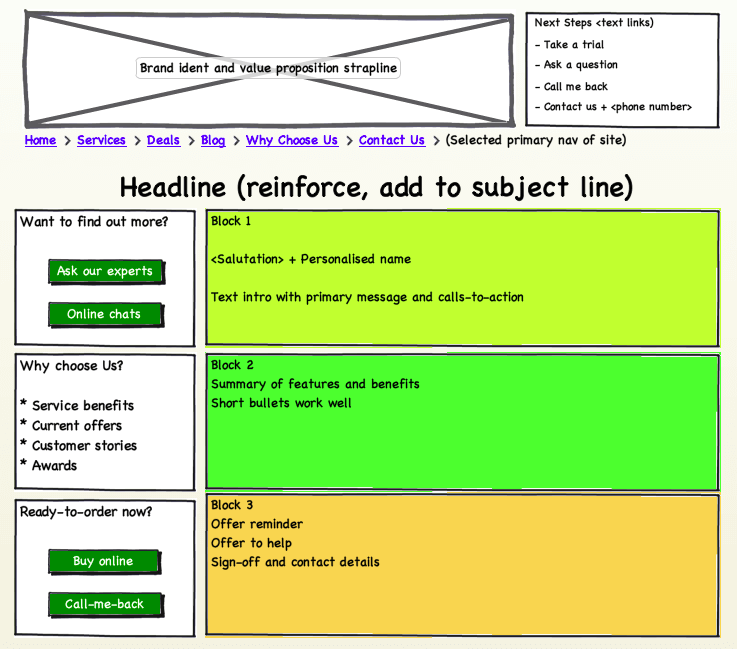
This more detailed example shows how a personalized communication can be specified within different blocks of an template - it's part of our template for planning welcome sequences.

Email creative wireframe example from campaign

This is the creative that corresponds to the contact strategy defined above. It is simplified into clear blocks that can be tailored for different waves in the campaign. The left sidebar which has a high visual emphasis, so is good for response is fixed and covers both branding and response goals.
We like the simplicity of Balsamiq for mocking up these types of layouts.

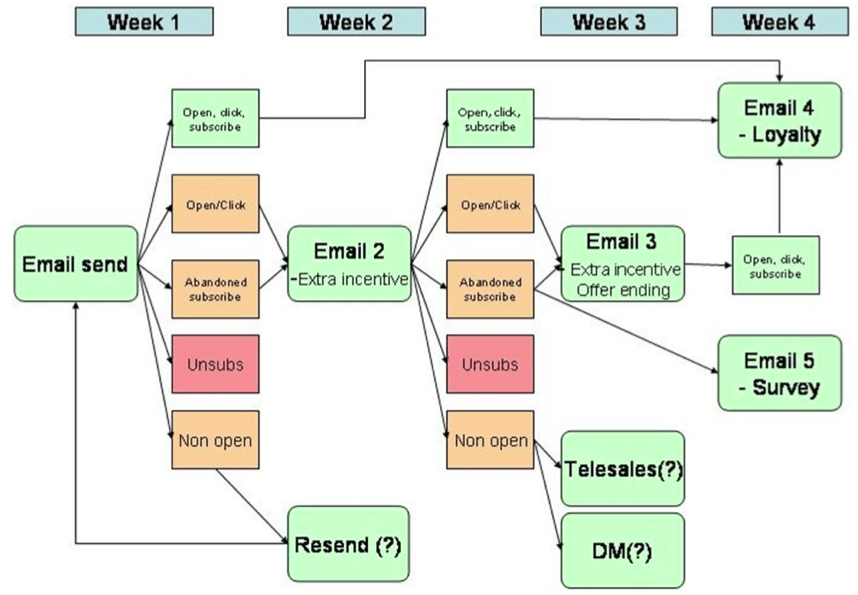
Example 3.  Using a flow-chart to summarise campaign waves

This example gives a more visual representation of a multi-wave campaign through time showing the "Sense and respond" or "digital body language" approach where follow up triggered communications depend on whether the email has been open or which links have been clicked upon.
A super-intelligent approach assesses the value of the customer and their propensity to convert and then follows up with the most appropriate medium to gain conversion. So a high value customer may receive a phone call or direct mail which could maximise conversion.

The Digital DNA - The State of eMarketing in India

The Digital DNA - The State of eMarketing in India

Highlights
  1. Customer Acquisition still remains the primary marketing goal for all marketers. However, we see an increase in votes for Customer Retention that saw an 80% increase since 2011. On the contrary, Brand Awareness dropped by 32% in 2015, despite a steady growth from 2011 to 2014.
  2. The impact of integrated campaigns increased by 84% from 31% in 2011 to 57% in 2015. With 54% Travel Marketers and 69% BFSI Marketers leveraging the most from these types of campaigns.
  3. Surprisingly, for 72% India Marketers ‘Websites’ is the primary e-Marketing activity in 2014. However for Retail & e-Commerce and Travel sector the primary e-Marketing activity is ‘Email Marketing’.
  4. Content Marketing is earning its place with India Marketers. 61% marketers believe ‘Blogs and Newsletter’ is the most effective content marketing tool. However for Education (63%), Retail & e-Commerce (71%) and Travel (55%) sectors, Social Media acts like a more robust tool for content marketing.
  5. ‘Reaching out to target audiences’ is the biggest Email Marketing challenge India Marketers faced in 2014, with 51% marketers agreeing to this statement. However, 60% of BFSI factors believe ‘inadequate segmentation’ was a bigger issue for them.
  6. ‘Frequency/volumes of sending’ is the most important factor that will impact Inbox Deliverability in 2015, replacing ‘content’ as the primary factor since 2011. ‘Sender Reputation’ is a growing concern for marketers, with 66% increase the last 5 years (36% in 2015 vs 21% in 2011).
  7. 100% of large companies (5000+ crores turnover) find Behavioural Targeting effective and the number of retail marketers that think Behavioural Targeting has brought significant change to their campaigns have increased by 24% (77% in 2015 vs 62% in 2014).
  8. 33% India Marketers think that over 50% of emails are viewed on mobile devices, seeing a YoY growth of 25%. BFSI sector is on the forefront with 39% BFSI Marketers’ reporting the same.

adapt by:

-Empowering Modern Marketing teams to deliver personalized Customer Experience across all channels.
-Provide Marketing Leaders with Data Driven Solutions that integrate directly with your systems.
-Enable Enterprises to better communicate with their customers and start new relationships that drive revenue.

India: Digital Market Overview

India: Digital Market Overview

A snapshot of digital India- 121m online users and growing fast

India is the third biggest country in terms of internet users in the world, with a highly social and mobile audience. This snapshot takes a closer look at India’s digital consumer, and the key trends driving the country towards a digital future. It's estimated as many as 121 million Indians are logged onto the internet. It is a sizeable number, but still a relatively small proportion of the country's 1.2 billion population.
india.jpg
India's internet
• 2% - Number of rural Indians using the internet
• 25% - Growth in Indian internet users in India over the past 12 months.
• 59% - Number of Indians who only access the internet via mobile devices.

What Indians do online
• 3 hours - Average time an Indian net user spends on social media.
• 13m - Number of Indians registered on matrimonial or dating sites.
• 70% of Indian internet users who watch online videos.

Source: wearesocial
Poor Internet connectivity, but phenomenal mobile growth
The Telecom Regulatory Authority of India estimates that there will be an additional 200 million new mobile subscribers in the coming year. According to research aggregated by wearesocial.net, there are more than 898 million mobile subscribers in India, 292 million of these living in rural areas.
The same data showed that 346 million Indian mobile users had subscribed to data packages, with more than half of all internet users in the country accessing the web via their mobile phone.
The increase in uptake of 3G and 2G services in India will also help get more people online. However, there are still issues getting this kind of connectivity into remote areas.

Other portable devices could also make an impact when it comes to Indians accessing the internet.
The government plans to roll out its low-cost tablet device, known as Aakash, into schools nationwide in 2012. Costing around $50, it has been hailed as a huge innovation for India and the way the web can be accessed in schools.
The devices are still very basic, compared with other tablets on the market, and rely on good wi-fi connections and electricity supply, prerequisites which are not always available in more remote parts of India.
In fact, one of the biggest challenges in the year ahead is increasing internet penetration in these areas.
Only 2% of rural India has access to the web, according to the Internet and Mobile Association of India (IAMAI). That's a small percentage when there is more than 70% of the population lives outside an urban conurbation.
Social media on the rise
Aside from access and reach, the other big change when it comes to India and the internet is how people are using the web. With better connections, mobile phones and computers, Indians are increasingly using the internet for more than just checking their email.
In both rural and urban areas, social networking is a key driver of use. The most popular site in India is now Facebook, which in the past six months saw its user base grow by more than a third.
Facebook has seen its market share grow by almost 50% from 2010 and 2011, while YouTube has shown a increasing growth rates in the first 4 months of 2012 and has been growing at over 400%. Twitter has yet to see a reasonable growth in India, despite having a fairly good adoption rates.
The professional networking site Linkedin is also seeing greater uptake in India. The country has the second largest number of users for the site, according to figures from socialbakers.com.
This net-savvy generation is also helping to build e-commerce in India. The number of transactions made online has been growing: in the past year, the value of online business in India was estimated to be worth about $10bn.

Some 13 billion adverts are already sent to mobile devices in India every month, and two thirds of all Indian e-commerce comes from mobile devices.
The biggest change, when it comes to content, will be the provision of more non-English websites in a country where hundreds of languages are spoken. Websites such as Wikipedia are already trying to push regional language content.

Monday, 6 July 2015